
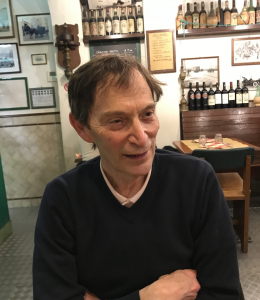
Medieval History, University of Glasgow
Since 1995, I have been Professor of Medieval History at the University of Glasgow. For most of this period, my work has centred on two areas: the history of popular unrest in late medieval and early modern Europe and the history of disease and medicine. These include books such as The Black Death Transformed: Disease and Culture in Early Renaissance Europe. Oxford University Press, 2002; Popular protest in late medieval Europe: Italy, France, and Flanders. Medieval Sources Series. Manchester University Press, 2004; Lust for Liberty: The politics of Social Revolt in Medieval Europe, 1200-1425. Harvard University Press, 2006; Cultures of Plague: Medical Thinking at the End of the Renaissance. Oxford University Press, 2010; Popular Protest in Late Medieval English Towns. Cambridge University Press, 2012; along with articles in Studi Storici, Les Annales, The American Historical Review; English Historical Review; Past & Present, Economic History Review, The Quarterly Journal of Medicine, and the Bulletin of the History of Medicine.
Since coming to Scotland, I have also enjoyed stints as a visiting professor at the University of California, Berkeley; Universiteit Antwerpen; L’Università degli Studi, Milano (Statale); and Aarhus Universitet, Denmark.
Projects
My principal scholarship at IASH has involved two large projects. The first probed two and a half millennia of disease and psychological history, which produced Epidemics: Hate and Compassion from the Plague of Athens to AIDS (OUP, 2018), funded by a two-year Pilot Programme Grant from the Wellcome Trust and then a three-year “Major Research Fellowship” from the Leverhulme Trust.
On the second one, I am still engaged. It interweaves cultural, religious, and art history with inequality studies during the late Middles Ages and Renaissance across most of the Italian peninsula and with two studies on each side of the peninsula: Catalonia and the Republic of Ragusa. On this project, I am the PI of a Five-year ERC Advanced grant, now funded by UKRI, entitled “Art and Inequality in the Shadow of the Black Death”. It is a team project of RAs and PhD students collecting, coding, and transcribing, thus far, over 20,000 records from numerous Italian, Spanish, and Crotian archives. On the art historical side, we are investigating documentation that has largely been ignored by art historians and has yet to be analysed quantitatively. These records pertain to commissions found in notarial records, mainly last wills and testaments, and include artworks to be maintained in public places, ordered from a wide spectrum of patrons (and matrons), ranging from nobles and international merchants on the one hand and artisans, peasants, and impoverished country widows on the other.
On inequality studies, we are breaking the monopoly currently held by economists and economic historians (at least before the nineteenth century), by going beyond economics as the only measure of inequality. In addition to economic criteria, we are concentrating on gender, geography, political status, culture, and religion to understand pre-industrial inequality and are finding that these manifestations of inequality do not always run parallel to those indicated by economic measures (see our evolving website: https://www.artandinequality.com/).