
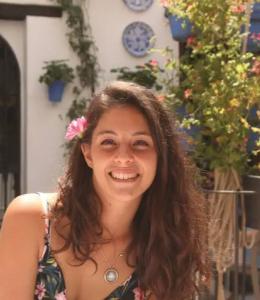
Dr Vanessa Montesi
Public Engagement Fellow, January - June 2026
Home institution: University of Sunderland
Vanessa Montesi holds a PhD in Comparative Studies from the University of Lisbon, where she completed a thesis on the intersections between dance and translation, published in 2024 by Leuven University Press (Dance as Intermedial Translation). Her articles on dance and translation have been published by TIS, JosTrans, Babel, Chaiers de Littérature Orale and other journals, and her first article on artistic representations of the impact of hostile environment policies and practices on couples and families appeared in Compendium: Journal of Comparative Studies. She collaborates with the Centre for Comparative Studies of the University of Lisbon, where is currently coediting a multilingual and multimedia zine on (co)habitation with Nicola Giansiracusa and Marzia D’Amico. She has been a research assistant for the Dramaturgical Ecologies Research Group led by Dr. Angélique Willkie at Concordia University, and a Lecturer in Dance Studies at the University of Sunderland. She is currently the Language and Learning Manager at Action Foundation, a charity supporting fellow migrants and people seeking sanctuary.
Project title: Loving Across Borders (LAB): Doing and Undoing Family Across the UK Border
This interdisciplinary research project stems from my personal experience of spouse migration from a European country to the UK post-Brexit to fill a gap in academic research and cultural production on international debates about family migration in the context of increasingly restrictive border regimes. Since 2012, the UK’s Spouse Visa procedures have separated thousands of families. Despite this, family migration has remained an under-researched area in the social sciences and humanities and has rarely made headline news within the national media. My project mobilizes artistic and activist practices to connect impacted families, university students whose future life choices may be limited by laws they did not vote for, and artistic and institutional actors active in the fields of marriage migration. Drawing on my previous experience as community engagement coordinator and founding member of a research group connecting the arts and public space, I employ a combination of interdisciplinary and participatory methods to explore the following questions:
- Intimate Repercussions and Artistic Representation: How do impacted people value and make sense of contemporary literary and performative artworks dealing with the emotional, psychological, and social consequences of migration policies hostile to families?
- Fictional Works and First-Person Accounts: What implications do these fictional and first-person accounts have for broader societal perceptions of migration?
- Engagement with Artworks In what ways can individuals participate in creative activities to raise awareness about family migration issues?