
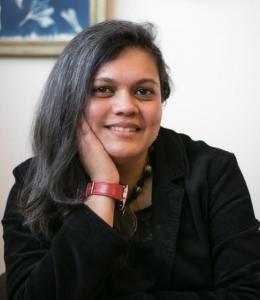
Dr Radhika Govinda
Sabbatical Fellow, June - October 2026
Radhika Govinda is Senior Lecturer in Sociology at the University of Edinburgh, UK, and the Director of the Una Europa Gender and Equality Network (UGEN). She also led GENDER.ED - the University's interdisciplinary hub for gender and sexuality studies from 2022-2025. Her research and teaching bridge the fields of sociology of gender, international development and South Asian Studies. She is author of Feminist Politics, Intersectionality and Knowledge Cultivation (2025), and co-editor of Doing Feminisms in the Academy (2020) and Gender in South Asia and Beyond (2024).
Project title: Archiving Feminist Knowledge Production in the Academy in Europe and India
Radhika's long-term intellectual project seeks to advance an archival and genealogical account of the emergence, institutionalisation, contestation and endurance of gender studies in the academy in Europe and India. With many in the generation of those who pioneered gender studies teaching and research now already retired, some even deceased, Radhika is keen to capture their particular contributions in their own voice before they are lost to future generations. This has become all the more urgent as courses, programmes and centres for gender studies are struggling to survive in the context of budget cuts and the rise and spread of political conservatism and anti-gender mobilisations. The project seeks to do more than recover neglected histories. It endeavours to offer critical tools for understanding the long-term conditions under which feminist knowledge survives and thrives in the academy despite being under threat. It also aims to complicate dominant Eurocentric accounts of feminist knowledge production in the academy.
As a sabbatical fellow, Radhika will be co-editing a journal special issue on 'Recovering Histories of Doing Gender Studies in European Universities as Feminist Intervention', which brings together scholarship by academics engaged in gender studies at universities in Scotland, Ireland, Germany, Poland and Switzerland. The papers in the special issue underscore how weaving together this collective history of gender studies in European histories is not merely retrospective work but a feminist political act that contests erasure, and seeks to secure and reimagine the field’s future. During her time at IASH, Radhika will also be working on a large grant application for research on archiving feminist knowledge production in India, delving into the otherwise marginalised histories and contributions of academic feminists as teachers, researchers and institutional leaders in Indian universities, and exploring how feminist knowledge is made, remade and sustained within shifting political and economic contexts, and beyond Eurocentric frames.