
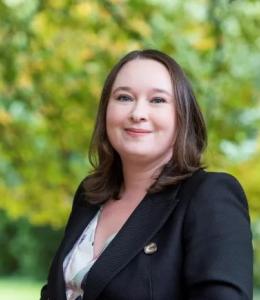
Dr Margarita Vaysman
Visiting Research Fellow, September - November 2026
Home Institution: University of Oxford
Dr Margarita Vaysman is Associate Professor of Nineteenth-Century Russophone Literature and Thought at the University of Oxford and Tutorial Fellow in Russian at New College. Before moving to Oxford in 2023, she spent six years as Lecturer, and then Senior Lecturer, at the University of St Andrews in Scotland. Dr Vaysman received her MPhil and DPhil degrees in Modern Languages (Russian) from Wadham College, Oxford, in addition to kandidat filologicheskikh nauk and spetsialist degrees from Perm State University in Russia. Dr Vaysman is a co-convenor of the 19th Century Study Group at the British Association for Slavonic and East European Studies (BASEES) and has recently been awarded BASEES Prize for Distinguished Excellence in Teaching.
Dr Vaysman’s research focuses on literary texts, primarily the Realist novel, and history of gender and sexuality. Her first monograph Self-Conscious Realism: Metafiction and the Nineteenth-Century Russian Novel was published by Legenda (Cambridge, Modern Humanities Research Association, 2021). This book explores instances of literary self-consciousness – a narrative technique that forces readers to be aware that they are reading a work of fiction – in Russian literature. The book has been reviewed in Russian Review (‘valuable’); Slavic and Eastern European Review (‘original’); Russian Literature (‘sophisticated and free from stereotypical approaches to its subject’) and Canadian Slavonic Papers (‘theoretically grounded, meticulously researched and well-argued’).
Her two co-edited volumes include Nineteenth-Century Russian Realism: Society, Knowledge, Narrative (NLO, 2020), which showcased the new interdisciplinary, inclusive approaches to the Russian canon (reviewed in Slavic Review as ‘pioneering’, ‘formidable’, an ‘essential reading for anyone who studies or teaches nineteenth-century Russian prose’) and The Oxford Handbook of Global Realisms (OUP, 2025), the first comprehensive interdisciplinary account of realism as a transnational and transhistorical tradition that is informed by globally diverse theoretical perspectives.
Dr Vaysman is now working on her second monograph, provisionally titled A Brave Life: Queer and Transgender Erasure in Russian Culture. Dr Vaysman’s work has been supported by international awards from the British Council, British Academy, British Association of Slavonic and Eastern European Studies (BASEES), Columbia University, Princeton University, Scottish Funding Council, UKRI and CEELBAS.
Project Title: A Brave Life: Queer and Transgender Erasure in Russian Culture
Dr Vaysman's project is a foundational contribution to the emerging field of studies of Russophone transgender cultures. Most transgender histories focus on Western Europe and North America post-1900, with some case studies of the Classical antiquity and the Global South. Dr Vaysman's work puts Eastern Europe on this discipline’s map, tracing the history of ongoing engagement with transgender subjectivities in the region. It does so by looking at six works by different authors across two centuries in literature, film and theatre, all featuring one protagonist – a Russian-Ukrainian transgender hero of the Napoleonic Wars, Aleksandr Aleksandrov (Nadezhda Durova) (1783-1866). A Brave Life asks what effect Aleksandrov’s gender identity had on how his story been told by himself and by others, and argues that his personal transmasculine identification has been gradually erased from cultural consciousness with each successive adaptation. The project aims to establish a list of common artistic techniques that erase queer subjectivities in popular adaptations of non-heteronormative autobiographies. It uses historical documents, narrative analysis, and adaptation theory to expose these techniques and counteract the ongoing global processes of transgender and queer erasure.