
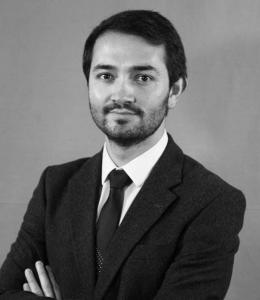
Dr Emrah Atasoy
Heritage Collections Postdoctoral Fellow, January - November 2026
Home institution: University of Warwick
Dr Emrah Atasoy is an Honorary Research Fellow at the Institute of Advanced Study and Associate Fellow of English and Comparative Literary Studies at the University of Warwick, UK. He completed his PhD in English Language and Literature at Hacettepe University, Ankara, Türkiye in 2019. A former Marie Skłodowska-Curie Cofund Fellow and Fellow of Advance HE, Emrah held research positions as a visiting scholar at Harvard University, Pompeu Fabra University-Barcelona (UPF-Barcelona), the University of Oxford, and Penn State University. In 2022, he was awarded the official title of “Associate Professor of English Language and Literature” by the Inter-University Board of the Republic of Türkiye. His research has been supported by grants and awards, including the Marie Skłodowska-Curie Cofund Fellowship (Horizon 2020), the Georg Forster Research Fellowship (Alexander von Humboldt Foundation, awarded but declined), the Alexander von Humboldt Foundation and The British Academy Knowledge Frontiers Symposium Participation Award (Berlin 2024), TÜBİTAK International Research Fellowships, and the DAAD Intensive Language Course Scholarship (Goethe Institute, Freiburg, Germany 2017). He also received travel bursaries from the Utopian Studies Society-Europe, the Science Fiction Research Association, and the Society for Utopian Studies (USA).
Emrah is the author of the monograph Epistemological Warfare and Hope in Critical Dystopia (Nobel 2021). This book explores how dystopian narratives such as Katharine Burdekin’s Swastika Night, Anthony Burgess’s The Wanting Seed, and P. D. James’s The Children of Men depict transformative journeys from ignorance to knowledge as forms of epistemological struggle and social engineering. The book argues that these critical dystopias use symbolic and influential strategies to question oppressive systems, embedding utopian impulses and revisionary epistemologies that may potentially lead to more just and meritocratic societies. He is also co-editor of Utopian and Dystopian Explorations of Pandemics and Ecological Breakdown: Entangled Futurities (Routledge Environmental Humanities 2024), as well as the critical forum “Cultural Encounters and Textual Speculations in the Mediterranean” (Utopian Studies 35.1 2024). His work appeared in journals such as Critique: Studies in Contemporary Fiction (with Marta Komsta), Studies in the Novel(with Thomas Horan), Utopian Studies, Science Fiction Studies, Librosdelacorte.es, Literary Voice, Methis. Studia Humaniora Estonica, SFRA Review, Nesir (with Burcu Kayışcı Akkoyun), and Journal of the Fantastic in the Arts, as well as on platforms such as The Conversation and The Institute of Art and Ideas. He also contributed chapters to edited collections including The Routledge Companion to Literatures and Crisis (Routledge 2024), Speculations of War: Essays on Conflict in Science Fiction, Fantasy and Utopian Literature (McFarland 2021), The Postworld In-Between Utopia and Dystopia: Intersectional, Feminist, and Non-Binary Approaches in 21st-Century Speculative Literature and Culture(Routledge 2021), and Les Llengües de la Ciència-Ficció: altres tradicions (Universitat Autònoma de Barcelona & El Biblionauta 2024). Emrah is and was a member of several scholarly associations, including Utopian Studies Society-Europe, the Society for Utopian Studies (USA) and the Science Fiction Research Association, as well as interdisciplinary networks such as ASLE-UKI, the Association for Medical Humanities, the Environmental Humanities Network at Warwick, and the British Academy ECR Network. His research interests span futuristic narratives, future studies, utopian and dystopian literature, speculative fiction, science fiction, environmental and digital humanities, Anthropocene studies, migrant literature, and world literature. He currently serves as section editor for utopian/dystopian studies, speculative fiction, and science fiction for The Literary Encyclopedia. His most recent publication is: Atasoy, Emrah and Jeffrey Wasserstrom (University of California, Irvine) "How George Orwell's Nineteen Eighty-Four predicted the global power shifts happening now" The Conversation. 19 January 2026. The Independent Link.
E-mail address(es): Emrah.Atasoy@warwick.ac.uk & atasoy.emrah@gmail.com
Project title: Archiving Futures: Utopia, Dystopia, Environmental Crisis, Identity, and Inequality in Edinburgh’s Special Collections
This project explores utopian and dystopian visions with a focus on environmental crisis through Edinburgh’s special collections. Drawing on rare books, activist archives, and historical materials, it investigates how these sources imagine identity, inequality, and resilience while engaging with questions of governance and social organisation. Using an interdisciplinary approach, the research combines literary analysis, political theory, and decolonial thought to critique anthropocentrism and structural exclusions. It examines whether speculative imaginaries reinforce exclusionary worldviews or create possibilities for more inclusive and ecologically grounded futures. By connecting archival storytelling with contemporary environmental humanities, utopian and dystopian studies, and future studies, the project aims to respond to the growing need for innovative methodologies that link cultural narratives to real-world societal challenges.