
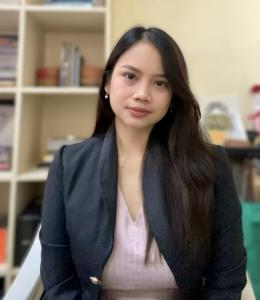
Dr Elsie C. Albis
British Council 90th Anniversary Research Fellow, January - December 2026
Home institution: Ateneo de Naga University
Dr Elsie C. Albis (she/her) is a teacher and theater practitioner. She teaches literature and theater at Ateneo de Naga University (ADNU), where she served as the chair of the Creative Endeavors Council (CEC) and founded the university's theater organization, Dulaang Agabaab.
She holds a PhD in Literature from the University of Santo Tomas, Manila, and was a fellow of the UST, DLSU Kritika, and Ricky Lee writing workshops. Her scholarly work has been published in various outlets, including the journal Filipinas and the CCP Encyclopedia of Philippine Art. She has also presented her research internationally, including at the University of Oxford (online).
As a theater practitioner, her plays have been featured in Pista Nin Teatrong Bikolnon in Albay, Philippines. She organized the Hablon Theater Festival and the Aligas Writers Workshop in Naga City, Philippines.
She is a recipient of the 90th British Council Anniversary Fellowship, which will take place at the University of Edinburgh, Scotland, in 2026. Her project supports IASH’s agenda of empowering local knowledge and the British Council’s goals through crossing or dakit, one of the root words for the Bikol term for translation (dakitaramon) and pakikipagkatuod (collaboration) with Edinburgh scholars in enduring, remembering, and responding to the tempests we universally face.
Project title: Translating The Tempest: Bikolisation of the Shakespearean Stage in the Philippines
This project began after my province experienced extreme flooding in October 2024, brought by Storm KristinePh. Theatre, for me, is a space for remembering and rebuilding. I am adapting The Tempest because its themes resonate with the stories of KristinePh survivors.
In 2016, the play, “The Tempest Reimagined” was staged in the Philippines as a tribute to the Yolanda survivors. Ten years later, our country continues to endure stronger typhoons, but the real tragedy often lies in what follows–corruption. The way history repeats itself makes my play a relevant rendition. Using Bikol as the target language, my play hopes to elevate the receiving culture’s linguistic and cultural norms, such as tigsik, its hybrid beliefs, and its Kadunungan, while exploring its sociopolitical milieu. My play will not be staged in a theatre house in Manila,“the so-called cultural center of the Philippines,” but rather in non-urban spaces for that is what Bikol theatre is as described by M.L. Realubit. Moreover, as natural and human-induced disasters intensify, so must the efforts of researchers and artists to engage in dialogues with the rural communities elevating these concerns through arts.
I see this not only as an academic pursuit, but as an act of advocacy that amplifies the voices of rural communities and links local memory to global conversations. Theatre is a powerful tool for collaboration and peacebuilding. Through translation, we can bring Shakespeare to Bikol and connect the UK to the Philippines. Together, we can produce a story—of storm, survival, and the will to hope.