
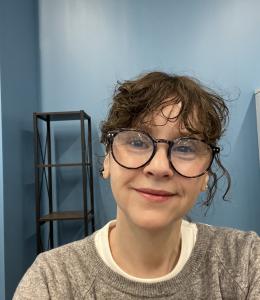
Dr Martina Karels
Home institution: St Francis College, Brooklyn
IASH-SSPS Fellow, May - July, 2026
Martina Karels received her Ph.D. in Sociology from the University of Edinburgh, and is now an Assistant Professor of Media and Communication at St. Francis College in Brooklyn, NY. She has two related strands of research, both grounded in a commitment to the politics of knowledge production. The first centres on remembrance as communicative practice and the dynamics of memory making, with particular attention to public spaces, digital archives, and emerging technologies as carriers and transmitters of memory. Her earlier work examined the memorialisation of 9/11 to analyse how public remembrances are framed, circulated, and maintained, and by whom. This focus is expanded in her recent collaboration with Dr Erin Hughes, which investigates the Assyrian diaspora's ‘networked memory work’ in the context of Assyrian genocide remembrance. In a second strand of research, she considers how the field of sociology remembers (and forgets) itself through the archiving and reuse of qualitative research data. As part of this inquiry, she co-leads an ongoing collaborative project on ‘DIY Academic Archiving’ (with Dr Niamh Moore, Dr Mary Hanlon, and Dr Nikki Dunne), which explores how research data can be made more accessible to both research participants and wider publics. Together they have created a DIY Archive (Clayoquot Lives: An Ecofeminist Storyweb).
Project title: From open data to feminist archiving: reimagining data sharing for the humanities and social sciences
New demands for depositing and sharing data across the humanities and social sciences (HASS) are largely driven by funders, by new modes of research governance (e.g. data management plans), and new digital infrastructures (e.g. library data repositories). These demands are often rejected by many critical researchers who understand such changes to be about further extraction of value from data (in part through additional labour of the researcher in order to prepare data for archiving), as well as retrenchment and redirection of research funding. The move towards open data appears as an externally enforced and unwanted imposition on researchers, arising from outside scholarly practice. Furthermore, that these proposed changes in research practice are often in direct contradiction with many qualitative researchers’ existing methodological and ethical commitments generally remains unacknowledged by research governance bodies and funders. Ethical commitments to destroying data as a way of protecting research participants, as well as concerns about informed consent, anonymity and the unknown future use of data, are all seemingly undone by calls to archive and share data (Moore et al. 2021).
The focus of the fellowship time will be on building new formulations of open data which are more consistent with the commitments of the social sciences and humanities. Taking up Haraway’s injunction that ‘it matters what stories we tell to tell other stories’ (Haraway 2013: 138), my project turns away from neoliberal and techno deterministic versions of open data to instead build on the possibilities afforded by learning from the field of archival studies and community archiving, specifically intersectional feminist archival theory and practice. In doing this I draw attention to what I see as some consequential missing archival turns across the social sciences and humanities. Specifically, I note that the social sciences have curiously not stretched ‘the archival turn’ to consider sociology’s own archive of its research data. Working at the nexus of digital humanities/archival studies/memory studies, and drawing specifically on insights from archival theory and archival practice, including the creative practices of community archives, my work argues for a move from ‘open data’ to intersectional feminist archival theory and practice as a way of reimagining data sharing for the humanities and social sciences.