
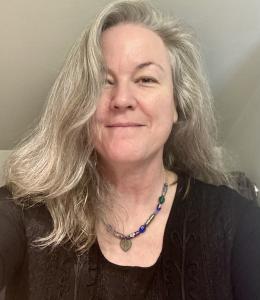
Professor Maeve Callan
American Philosophical Society Fellow, May - July, 2026
Maeve Callan is the Bishop Matthew Simpson Endowed Chair of Religion at Simpson College in Iowa and the author of The Templars, the Witch, and the Wild Irish: Vengeance and Heresy in Medieval Ireland and Sacred Sisters: Gender, Sanctity, and Power in Medieval Ireland, and, with Maggie Solberg and Valerie Traub, co-editor of the forthcoming Reproductive Justice after Roe: Lessons from the Premodern Classroom. She is an IASH fellow this summer thanks to the generous support of the American Philosophical Society’s Franklin Research Grant (named in honor of Benjamin Franklin, one of the founders of the Society, America’s oldest scholarly organization). This project is part of her current monograph, Fatal Destiny: Religion, Racism, and the Making of Medieval Britain and Ireland, which focuses on the millennium-plus between the end of Britain’s time as a Roman colony in the fifth century and the start of its global imperialist domination in the sixteenth to analyze how religion and racism intertwined to lay the foundation for the white supremacist and Christian nationalist forms that plague our world today.
Project title: Nostra Natio: Religion, Ethnic Amalgamation, and the Forging of the Medieval Scottish Nation
My project, “Nostra Natio: Religion, Ethnic Amalgamation, and the Forging of the Medieval Scottish Nation,” takes its title from Robert Bruce’s 1307 letter proclaiming the Irish and Scots a single people who shared “one national origin” and exhorting them “to come together in love, more eagerly and joyfully, by a common language and by common custom . . . so that with God’s will our nation [nostra natio] may be able to recover her ancient liberty.” I contrast that letter with the 1320 Declaration of Arbroath and contextualize those documents with other evidence that both supports and undermines a shared “Celtic” identity at this time. I focus on evolving Scottish medieval ethnic identity, drawing on archaeology as well as medieval texts from Gildas’s 5th-century On the Ruin of Britain through Bower’s 15th-century Scotichronicon. I further consider medieval Scottish identity’s ongoing echoes, as in the 19th-century American confederacy and among other white supremacists in the 20th and 21st centuries.