
Event date:
Wednesday 3 August
Time:
13:00
An IASH Work-in-Progress seminar, delivered by Dr Kristján Ahronson (Northern Scholars Visiting Research Fellow 2021-22; Wolfson College, Oxford)
Scotland, tephrochronology and the problem of Iceland’s Viking-Age artificial caves: a case for inter-disciplinary reflection
The first settlement of Iceland is traditionally seen within a model of western Viking expansion, with earlier settlement (before c.AD 870) having a more elusive status. Emerging evidence for earlier monastic settlements and anthropogenic landscapes requires a holistic cross-disciplinary view, taking account of data from a number of disciplines.
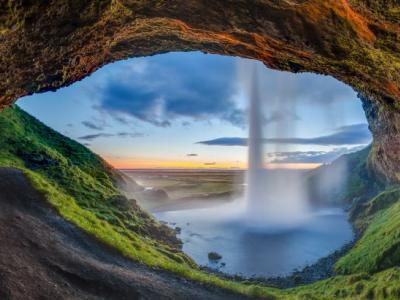
Many of southern Iceland’s c.200 artificial caves are marked by cross sculpture, and the most remarkable in this regard are at Seljaland. Building on my Into the Ocean: Vikings, Irish and Environmental Change in Iceland and the North (University of Toronto Press, 2015), our Project uses photogrammetry: making new discoveries and also innovating using volcanic airfall (tephra) to reveal tantalising insights into life and ecologies at Iceland’s apparently earliest settlement.
Our work includes a fuller understanding of the Seljaland caves themselves, identifying a substantial number of previously unrecorded crosses, and sequencing the sculpture. The suite of typological similarities in the cross sculpture makes a persuasive case for connections between Icelandic and Scottish cave sites.
Our fieldwork on an area of raised pastureland also uses photogrammetry to develop tephra contouring as a new technique for investigating past landsurfaces, as an original archaeological innovation within a geological paradigm. By contouring the micro-detail of 3D surfaces of airfall from volcanic eruptions c.AD 920 and AD ~870, we explore questions of ninth- and tenth-century deforestation in coastal Iceland … and apparently discovered sheep or goat tracks through freshly deposited tephra, which could prove to be amongst the earliest evidence yet discovered for Viking-Age Iceland’s domesticated animals and accompanying transformation of wild environments into “domesticated landscapes”.
Please click the link below to join the webinar:
https://ed-ac-uk.zoom.us/j/86535202023
Passcode: Vr8f3ew2