
“Speaking with Care: Rethinking Narratives of Neurodegenerative Conditions”
A Susan Manning Workshop, 22 May 2026
Dr Malgorzata Bugaj, Dr Georgi Gill, Dr Benedetta Catanzariti
“Speaking with Care: Rethinking Narratives of Neurodegenerative Conditions” focused on the ongoing and growing challenges of talking about multiple sclerosis, Parkinson’s disease and dementia. Its main aim was to promote more thoughtful and respectful discussions about these conditions, recognising such dialogue as a form of care and social support. We wanted to bring attention to underlying assumptions in representations of neurodegenerative conditions across the arts, humanities and sciences. The event also explored avenues for practical applications of research findings ‘in the real world’ beyond academia, with a commitment to listening and co-creating knowledge. This is particularly urgent at a time when charities and the care sector are facing a funding crisis even as demand for their services continues to rise.
“Speaking with care” was open to the general public. The event gathered participants with lived experience of neurodegenerative disease, charity representatives and academics working within the field. It was envisioned as a knowledge-exchange activity to further collaborations between these stakeholders, within the UK and on an international basis. It began with flash talks from the organisers, who shared their work from the field of health humanities intersecting with film and media studies (Malgorzata Bugaj), poetry (Georgi Gill) and science and technology studies (Benedetta Catanzariti). Malgorzata Bugaj referred to her work from Dementia in Film, Media and Culture: Towards Ethically Responsible Discourse (eds. Bugaj and Stewart, EUP, upcoming), spotlighting how popular film reviews can be useful beyond cultural commentary itself. As Malgorzata proposed, film criticism that is both informed and informative can itself be an opportunity for social care and support.
Georgi Gill gave a brief overview of her research project, ‘poeMS: the possibilities of poetry written by people living with multiple sclerosis’. She also shared some participant poems, highlighting the benefits of exploring neurodegeneration though group poetry workshops, both as social support for participants and a method of data creation. Finally, Benedetta Catanzariti shared her work on the values and assumptions embedded in medical Artificial Intelligence (AI) for the prediction of Alzheimer’s Disease. In particular, she showed how narratives of prediction tend to focus on decline, crisis, and loss of independence and can shape patients’ identity, sense of self and social relations, as well as notions and practices of care.
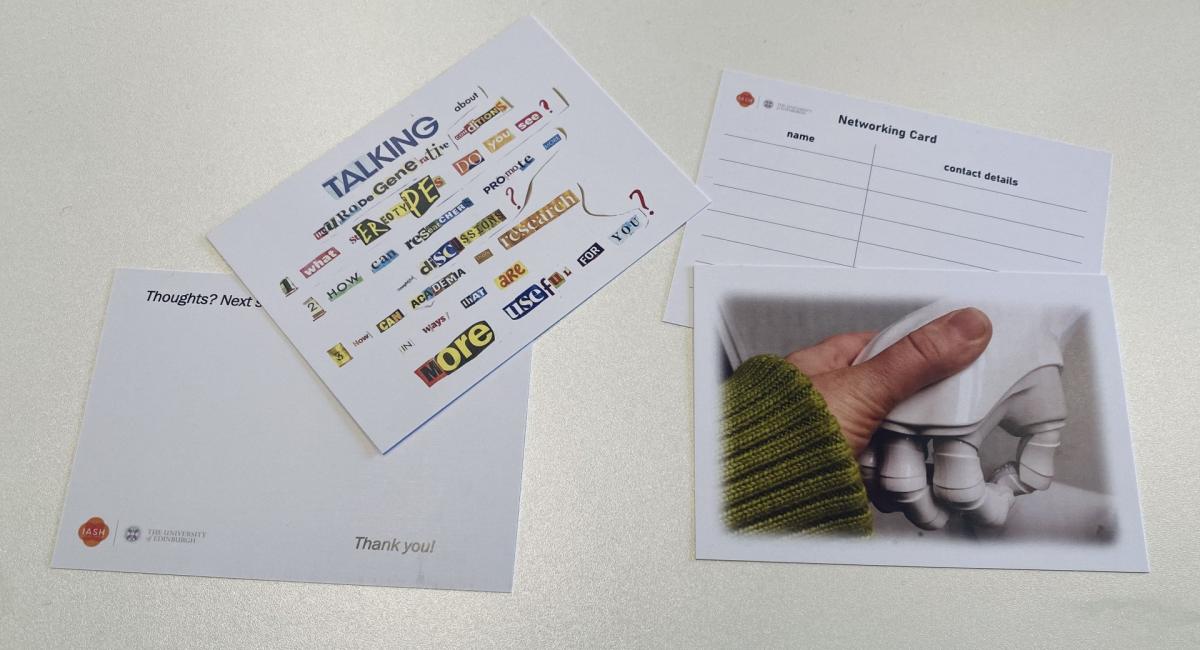
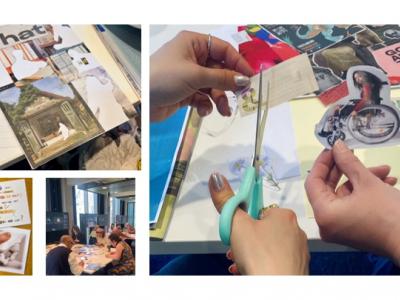
During the creative workshop, the participants had an opportunity to respond to the flash talks and reflect on which aspects of neurodegenerative lived experience they would like to see better represented and disseminated to the wider community. Some participants responded through found poetry, a form in which the poet takes existing text and reshapes it to make a poem. One found poem explored how shared experiences of neurodegenerative conditions can create the sense of community and connectivity. Another included insightful and witty observations on the nature of care, diagnosis and technology. A selection of words and phrases encountered by chance in magazines reflected on inclusive communication between academics, promoting thoughtful dialogue that supports social inclusion and creative understanding.
Some participants opted for collages. The image of holding hands stood for a challenge to common assumptions about neurological respite care; although many view it as difficult and depressing, the participant described it as a place of warmth, joy and hilarity, calling for greater focus on the person, not the condition. This message was echoed with cut-out silhouettes and role-based questions which highlighted how the over-reliance on “what” question can reduce the experience of real people (“the who”) to their diagnosis (“the what”). A busy assemblage of images and magazine headlines, with an added handwritten phrase, “I remember existing without stares”, explored the multi-faceted and personal experience of living with complex health conditions. It not only reflected on the theme of societal stigma but also expressed hope and promoted more positive representations. Hope and faith were also emphasised by a participant living with Parkinson’s, who described them as essential forms of care, as important as treatments, medication and carefully managed daily routines. Negative visual stereotypes of neurodegenerative conditions juxtaposed with positive, vibrant imagery questioned how care, community and representation might be imagined in the future. Another contribution drew attention to the diverse experiences of families and friends who support people on their heath journeys; such unpaid care work often goes unseen by others, including care professionals.
Participants mentioned harmful stereotypes around people living with degenerative conditions, such as being infantilised or seen as “helpless”. Particularly painful concerns were voiced with regards to associating dementia with “living death”. Participants with lived experience also highlighted that their symptoms are often misunderstood. For example, Parkinson’s is almost exclusively associated with tremors, while other manifestations of the condition are disregarded. Dementia tends to be reduced to memory issues. MS gait is often misinterpreted as a result of alcohol consumption. In response, participants suggested educating wider audiences better about neurodegenerative conditions. Several participants talked about the importance of fun and creativity. Activities such as collage or found poetry were seen as validating people’s experiences, while offering opportunities for joy and connection, and exploring their lived experience in new ways. Participants also suggested adopting a more communal approach to care and research. For researchers communicating with wider audiences, this should involve more accessible language and avoiding terminology that can be vague or difficult for non-academic audiences to understand, which often includes experts by lived experience. An important recommendation was to continue creating safe and welcoming spaces where researchers, people living with neurodegenerative conditions and care partners can engage in open dialogue beyond formal settings. Participants also advocated for facilitated hybrid events with additional support measures to enable meaningful participation of people with lived experience, reflecting the principle of “nothing about us without us”.
Click here to view the video in a new window.
You can see participants' works created during the event here.
We are grateful to IASH and the Susan Manning Workshop Fund for making this event possible.