
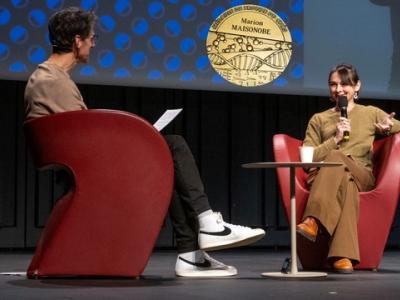
Former Fellow Dr Marion Maisonobe (IASH-SSPS Fellow 2018; 2019) has been awarded the 2025 Bronze Medal from the CNRS (Centre national de la recherche scientifique), France's state research organisation.
Each year, the CNRS awards silver, bronze and crystal medals to scholars who have made the greatest contribution to its reputation and to the advancement of research. The bronze medal rewards initial research that has established a researcher as a specialist in their field. This distinction is a form of encouragement to pursue research that is already well underway and proving successful. The CNRS awarded 46 bronze medals in 2025.
Marion Maisonobe defended her doctoral thesis in Geography in 2015, under the supervision of Denis Eckert, on the theme: “Studying the geography of scientific research in the world: from the growth of the contemporary production system to the dynamics of a specialty, DNA repair”. She came to IASH first in 2018 and returned in 2019. She also visited Science, Technology and Innovation Studies (STIS) in SPS two years ago in the context of a RSE Saltire Award on the Geography of Collaboration (GEOCOLLAB) where she worked with Prof. Niki Vermuelen and others on the history of marine science institutes across Scotland and Brittany; they are now working together on the follow-up project OCEANLINKS, funded by the ANR in France. As a member of the Géographie-cités’ PARIS team, Dr Maisonobe currently investigates the dynamics of scientific networks in different areas of research and their effects on the circulation of knowledge, international relations, and the organization of national research policies. Her research falls within the fields of the geography of science and spatial scientometrics, two emerging fields that focus on the spatial dimension of the production and dissemination of scientific knowledge. Recently, she has turned her attention to the spatial logics of field and environmental sciences. Her work, which contributes to the renewal of the objects of spatial analysis, brings to light the way in which scientific collaboration activities unfold between cities and helps to boost inter-city exchanges.
Image courtesy of Professor Niki Vermuelen.