
A guest blog by Dr Tom Harrison, 2020 Library Fellow:
Amongst its many other treasures, the University of Edinburgh’s Centre for Research Collections houses the Halliwell-Phillipps collection, a unique set of Shakespearean materials originally belonging to the nineteenth-century antiquarian James Orchard Halliwell-Phillipps. The collection was bequeathed to the Library in 1872 by Halliwell-Phillipps, with the bulk of the materials arriving between that year and the scholar’s death in 1889; a second Halliwellian collection, originally gifted to Penzance Library, was purchased in 1964. Halliwell-Phillipps was an avid, one might even say obsessive, collector, and the curious visitor to the CRC will find a wealth of material at their disposal, including hundreds of original quartos of early modern plays and over a hundred of Halliwell-Phillipps’ own note- and scrap-books, which document the depth and breadth of his researches into all things Shakespearean that dominated most of his adult life.
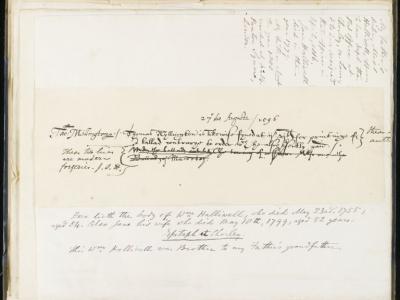
My research as an IASH Library Fellow focuses on Halliwell-Phillipps’ ‘literary scrapbooks’, a chaotic jumble of notes, draft copies of his numerous books and pamphlets, cuttings from contemporary books and newspapers, and—an inclusion that may still the heart of a modern bibliophile—fragments of early print text, which have been cut from their original texts and pasted into his own. Although a greater reverer of Shakespeare’s works and his life, Halliwell-Phillipps seems to have viewed these early materials as fair game for the chop, and his scrapbooks are scattered with clippings from works as varied as Robert Allott’s Englands Parnassus (1600), Raphael Holinshed’s Chronicles (1587), Thomas Adams’ Diseases of the soule (1616), Giraldi Cinthio’s Hecatommithi (1593), and Ben Jonson’s Workes (1616). My project will catalogue these early print extracts to document the range of Halliwell-Phillipps’ reading for future users of the collection. In an era that was not yet to know the joys of Ctrl + C and Ctrl + V, Halliwell-Phillipps’ own methods of cut and paste are understandable (if not forgivable) attempts to manage his vast range of evidence, and it would be of use to discover a little more about the origins of his pilfering.
If his attitudes to book preservation leave much to be desired, modern scholars are indebted to Halliwell-Phillipps’ dedication to unearthing details of Shakespeare’s biography, the majority of which would be presented in the Illustrations of the Life of Shakespeare (1874) and the monumental Outlines of the Life of Shakespeare (1887, 7th ed.). One of Halliwell-Phillipps’ biographers describes the man as a ‘literary archaeologist’, and his scrapbooks show the results of many patient years of digging away in the archives for any trace of Shakespeare and his life. They are filled with notes not just about Shakespeare but about his life in Stratford-upon-Avon and his family. No detail is considered insignificant: the scrapbooks contain careful transcriptions of bills paid by Shakespeare’s grandson-in-law, Thomas Quiney; notes on a will witnessed by John Shakespeare, the playwright’s father; even a list of baptism records for the Harts, the last branch of the Shakespeare family that died out in the eighteenth century.
Halliwell-Phillipps’ notes can sometimes be a challenging read—non sequiturs abound, and his writing is full of crossings out and rewrites—but what shines through every page is his commitment to revealing as much as he can about Shakespeare’s life, art, and family. Perhaps most poignantly are his notes on Shakespeare’s last will and testament. He attempts to address that great puzzle of Shakespeare’s will—his gift of his ‘second best bed’ to his wife Anne—by suggesting that she was bequeathed nothing else because of a ‘chronic infirmity’. One wonders whether this supposition was borne from Halliwell-Phillipps’ own life experience, for his first wife Henrietta was to suffer from a similar affliction before her death in 1879, having never recovered mentally or physically from a dreadful carriage accident a few years previously. Such a perceived connection in the lives of biographer with their subject is not uncommon, and would indeed be consistent with a man who would publish a light-hearted but not entirely unserious list of personal qualities and experiences shared between himself and the man he termed ‘the great dramatist’ (both from lowly backgrounds, both had fathers who worked in trade, both to an extent social outsiders, and so on). Although he prided himself on the methodical, objective rigour he brought to his explorations, it is hard not to see in Halliwell-Phillipps’ thoughts on Shakespeare’s will a moment where the personal has combined with the professional.
Halliwell-Phillipps may be a literary archaeologist, but his manuscript collection in the CRC is an archaeological site. My own research has just started with the top soil, brushing away at fragments of literary pottery, but there is much more to be explored about how the scrapbooks trace the development of the man’s ideas and of his reading habits. More discoveries await the trowel and spade of further research!
In further Shakespeare-related news, IASH is delighted to be sponsoring an event at the Edinburgh International Book Festival, Maggie O’Farrell: Giving New Life to Shakespeare’s Son on Saturday 15 August at 7pm BST, in which renowned author Maggie O'Farrell will discuss her brilliant new novel Hamnet. "In a short but scorchingly emotional book, O’Farrell brings us into the 16th century world of Shakespeare’s family living in Stratford. It is the time of the bubonic plague and with one of the family members falling into a fever, the novel charts the emotional journey of Shakespeare’s wife Agnes as trauma approaches. Surely Maggie O’Farrell’s most accomplished novel to date, Hamnet centres around the emotional life of a deeply intuitive woman, charting the terrain of her grief at the loss of a child." The event is free to watch online: https://www.edbookfest.co.uk/the-festival/whats-on/maggie-o-farrell-giving-new-life-to-shakespeare-s-son