
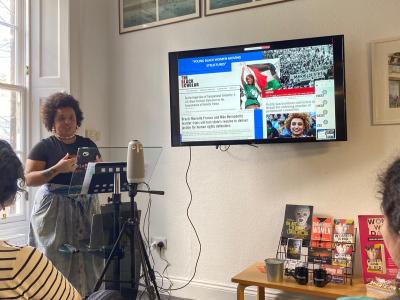
The Dangerous Women Project began at the University of Edinburgh on International Women's Day 2016, asking "what does it mean to be a dangerous woman?" A decade on, the Project has produced over 350 essays, three brilliant books, a whole host of events and a community of authors around the world. For International Women's Day 2026, IASH hosted a celebration of a decade of Dangerous Women. A new generation of writers offered short insights into their own favourite women from history and the modern day. From educator and activist Chief Funmilayo Ransome-Kuti of Nigeria to priestess Baliana from the Philippines, not to mention Nancy Cunard, Marielle Franco and more, these stories of resistance and resilience add to the rich tapestry woven since 2016. In the words of Mary Beard, the Project is "a great chance to explore what we expect of women, of how they should behave and of what counts as women ‘stepping out of the line’."
Speakers included:
Elsie C. Albis on Baliana, a priestess from Bikol in the Philippines. She existed before colonisation and has been paganised, but her memory and presence in the lives of Bikolnons are now being reclaimed.
Kate Ash-Irisarri on Isabel, Countess of Buchan (13th/14th century). She took a vital role in Robert the Bruce’s inauguration, but was written out of Scottish history and vilified in English sources.
Anna Girling on Nancy Cunard (1896-1965), a British writer, publisher, editor and activist. Cunard’s anti-colonial and anti-fascist writings from the 1930s make her a figure of immense relevance for today.
Helen Shutt on Chief Funmilayo Ransome-Kuti (1900-1978), a Nigerian educator and women's rights activist, dubbed the 'Lioness of Lasabi'. Less well-known than her son Fela Kuti ('founder' of afrobeat), she was a formidable advocate for women's rights and education, and in particular challenging the crippling taxes imposed on market women by the colonial administration.
Georgi Gill on Anna Burns (1962-), a Northern Irish novelist who won the 2018 Booker for Milkman. Politics, society and gender are deeply imprinted in all her work, exploring what it is to be a woman during the Troubles in voices that are both experimental and deeply recognizable. Burns is also disabled by chronic ill health which has led to her being, at times, impoverished and homeless, and probably the only Booker winner to thank a housing charity and a foodbank in her acceptance speech.
Jéssica Hipolito on Marielle Franco (1979–2018), a Black, queer Brazilian sociologist, human rights activist, and city councillor in Rio de Janeiro, who fought against police violence, racism, and gender inequality, focusing particularly on the rights of favela residents, Black women, and LGBTQ+ communities. She was assassinated in 2018, and her life and death have become a global symbol of resistance to authoritarianism and state violence.
Sheelalipi Sahana on Gulfisha Fatima (1993-), an Indian Muslim political prisoner incarcerated under the draconian Unlawful Activities (Prevention) Act, for challenging anti-Muslim citizenship laws and the crackdown on illegal migration. Her resilience to repeatedly being denied bail and imprisoned without trial stood as a testament to her belief in upholding the Indian Constitution’s human rights mandate.
Professor Hazel Hall wrote a blog reflecting on the event, which you can read here.
All the presenters spoke with passion. Georgi, a self-confessed Anna Burns fan-girl, for example, enthusiastically encouraged audience members to read her subject’s work... There was also an element of performance in the presentations, for example when Sheelalipi read out some of Gulfisha Fatima’s poetry.
Despite the constraints of the seven minute slots, all the speakers made a strong case for those profiled to be considered ‘dangerous women’. Thanks are due to all who presented, and to the team that organised this celebration of International Women’s Day 2026, highlighting the long-term legacy of the Dangerous Women Project.
Image by Emrah Atasoy.