
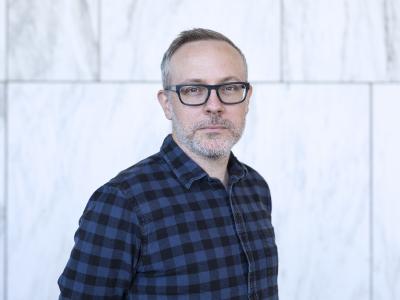
An IASH Work-in-Progress seminar, delivered by Jacob Boswell (Fulbright Scotland Distinguished Scholar Fellow, 2025-26).
Toward 4th Stage Energy Urbanism
Urbanism has always been shaped by energy in relation to climate. Pre-modern urbanisms and their constituent parts: urban forms, architectures, open spaces, transportation infrastructures, can often be read as a direct reaction to the nexus of climate, technology, and available material resources. That neat framing begins to dissolve with industrialization and, with the exception of transportation, is almost totally opaque in post-modern, globalized cities. That opacity, and the spatial logics that produced it, and continue to produce it, present emerging problems for the transition to renewable energy. Most experts agree that the renewable energy transition is no longer a technical problem. We have the technical capacity to make the transition on a global scale. Yet the distributed generation and storage technologies of the renewable transition, many of which are quite familiar at this point, are often a poor fit with post-modern spatial and distributional logics, cultural norms, and forms and patterns of urbanism that persist in contemporary cities. While we may increasingly attempt to build our cities to conserve energy, we do not yet do so in ways that adapt to let alone recognize or celebrate renewable energy’s material, spatial, and temporal dimensions. Early transition urbanism simply crams a new set of logics into the spatial form and cultural habits of a past regime. I believe this is a missed opportunity to create a more just transition for both humans and non-humans and one that brings urbanism back into a clear, legible relationship with the rhythms of energy that sustain it. My work in Scotland has focused on documenting the idiosyncratic logics of the multitude of community-owned distributed energy resources built since 2009. Those projects, while small and mostly non-urban, sometimes point to an emerging capacity to presence energy infrastructure in our towns and cities in new ways. This talk will be divided into three parts: a brief historical reflection on how past urbanisms operated under prior energy regimes, an overview of Scottish community-owned energy facilities and their spatial and material logics, and an early glimpse of design proposals that deploy those logics as media for a 21st-century energy urbanism.
Meeting ID: 384 971 962 716 1
Passcode: nV6Rg79e