
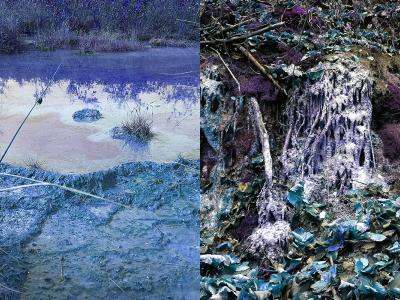
This panel presentation brings together arts and geoscience researchers to discuss anthropogenic tufa—a form of limestone induced by human industrial activities. Speakers include members of a collaborative team working to create an experimental tufa artwork in the foyer and courtyard of the University of Edinburgh School of GeoSciences Grant Institute and Cockburn Museum.
In living systems, tufa forms when calcium-rich water flows over soil and biological matter, interacting with carbon dioxide from the air. This ‘hard’ water can also calcify human-made objects and captures particles of waste or air pollution that enter its flow. Like ocean carbonates and sedimentary limestone formations, the chemical reaction with CO2 sequesters atmospheric carbon. Anthropogenic tufa is generated at sites where human industry and intervention have altered the water chemistry, one local example of this is a steel slag heap at Ravenscraig (N Lanarkshire).
This interdisciplinary research develops further understanding of human-made tufa through creative application within a tufa ‘fresco’ made for the Grant Institute courtyard. We propose that the artwork will also become a time-based geological model of anthropogenic tufa chemistry, formation and structure, monitored by staff and students who will collect samples and data from the artwork as the tufa accumulates and changes over time.
The event is supported by the Susan Manning Workshop Fund from the Institute for Advanced Studies in the Humanities, and the Centre for Research Collections at the University of Edinburgh. The panel is chaired by Cockburn Museum Curator, Dr. Gillian McCay, and organised by IASH Heritage Collections fellow Dr Raewyn Martyn, who has been working with the Geological Models Collection to research the site-responsive art installation at the Grant Institute. Speakers include members of the collaborative team, Dr Susan Cumberland and Dr Marta Kalabová, from University of Leicester, and University of Strathclyde, who have developed human-made tufa as part of research into the regeneration and remediation of post-industrial landscapes. They are joined in conversation by renowned Glasgow-based artist Ilana Halperin, who has also researched tufa and other new geologies. We look forward to bringing these practice-based perspectives together to discuss the creativity of tufa and experimental geology.
Reserve a free space on Eventbrite: https://www.eventbrite.co.uk/e/creative-tufa-experimental-geology-tickets-1306716988689?aff=oddtdtcreator&referrer=https%3A%2F%2Fcreativetufa.eventbrite.co.uk%2F