
The Constitution of India has been widely viewed as a transformative document and a founding charter for independent India. This narrative has meant that critical engagement with the contents of the Constitution has been inadequate and has often been drowned out by hagiographical accounts.
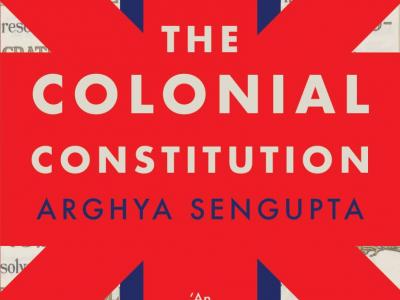
In this online talk, Dr Arghya Sengupta will explore the genesis of the Indian Constitution based upon his recently published book, The Colonial Constitution: An Origin Story (2023). Through an in-depth analysis of historical records, including the constitutional writings of Mahatma Gandhi, the anti-caste leader and constitution-maker Dr B.R. Ambedkar, and the Hindu nationalist V.D. Savarkar, as well as debates of the Constituent Assembly, the book argues why the Constitution of India is a colonial document, and unveils its origin story.
Register free at https://colonialconstitution.eventbrite.co.uk
Speaker:
Arghya Sengupta is the Founder and Research Director of the Vidhi Centre for Legal Policy. At Vidhi, his areas of specialization are constitutional law and regulation of the digital economy. He is also the author of the acclaimed book, Independence and Accountability of the Indian Higher Judiciary (CUP, 2019). He has written extensively in leading peer-reviewed journals and collections include the Law Quarterly Review, Public Law and the Oxford Companion to Politics in India. He has most recently co-edited Working a Democratic Constitution, a special edition of the IIC Quarterly. He is a columnist at the Times of India and the Telegraph. An alumnus of the National Law School of India University (Bengaluru), he was a Rhodes Scholar and Lecturer in Law at the University of Oxford.
Discussants:
Rochana Bajpai is Professor of Politics at SOAS, University of London. Her monograph Debating Difference: Group Rights and Liberal Democracy in India (OUP, 2011) offered the first systematic analysis of the Indian Constituent Assembly debates (1946-50) on group differentiated rights, focusing on religious and caste minorities. Rochana is a founder member of the SOAS Centre for Comparative Political Thought and co-convenor of the London Comparative Political Thought Research Group. She is currently principal investigator of Pluralist Agreement and Constitutional Transformation (PACT), funded by the Arts and Humanities Research Council (AHRC).
Harshan Kumarasingham is a Reader in Politics and History at the School of Social and Political Science, University of Edinburgh. Before joining the University of Edinburgh, Dr Kumarasingham held several important research and teaching positions including a Smuts Fellowship in Commonwealth Studies at the University of Cambridge and lectureship at the Ludwig Maximilian University at Munich. In 2023 he was awarded the prestigious Friedrich Wilhelm Vessel Prize for his work on legacies of Empire and constitutional studies from the Alexander von Humboldt Foundation and German Federal Ministry of Education and Education. His most recent publications include Viceregalism: The Crown as Head of State in Political Crises in the Postwar Commonwealth (Palgrave Macmillan, 2020) and The Cambridge Constitutional History of the United Kingdom - 2 Volumes (Cambridge, 2023) (co-edited with Peter Cane).
Alok Oak is a Postdoctoral Research Fellow at IASH, University of Edinburgh where he is working on the Scottish Constitutional historian of the British Empire, Arthur Berriedale Keith (1879-1944). His PhD dissertation (University of Leiden, 2022) was an intellectual biography of the Indian nationalist leader and conservative thinker Bal Gangadhar Tilak (1856-1920). Previously, he has taught at the School of History, University of St Andrews.